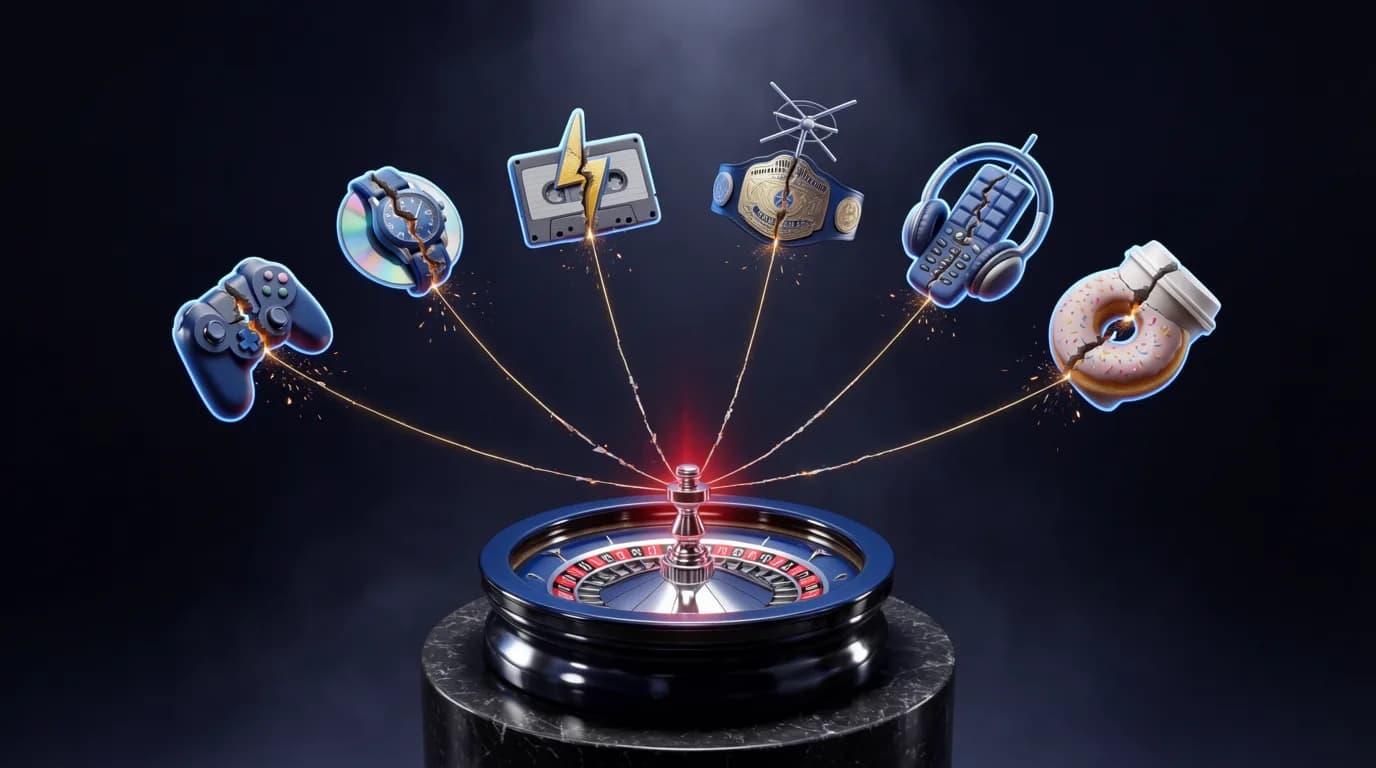
TL;DR for innovation departments: Six case studies of collaborations nobody saw coming that all died: Nintendo × Sony, Swatch × Mercedes-Benz, Enron × Blockbuster, WWF × NBC, Apple × Motorola and McDonald's × Krispy Kreme. Five failure modes caused them: partnership as press release, control fights, contracts that detonate late, deadline-driven launches, and unit economics nobody modelled. The lesson is not that unusual pairings are dangerous. It's that unusualness doesn't buy an exemption from the boring checks.
There's a simple test for whether a partnership is worth your attention: your first reaction should be "wait, what?" I made that argument in a post about unusual collaborations that proved everyone wrong.
Honesty demands the other half of the data set. For every Nike × SKIMS, there's a joint venture that burned nine figures and vanished. The graveyard of unusual partnerships is bigger than the trophy cabinet, and it's the more instructive half, because the tombstones have causes written on them.
Here are six pairings nobody saw coming. All of them died. The reasons repeat.
1. Nintendo × Sony: the betrayal that created a rival
In 1988 the world's biggest console maker asked a consumer electronics giant with no games business to build a CD-ROM add-on for the Super NES. Work proceeded for nearly three years. At the June 1991 Consumer Electronics Show, Sony unveiled the joint console. The next morning, Nintendo announced it had signed the same deal with Philips instead, having quietly concluded the contract gave Sony too much control over CD-based games.
The collaboration died on stage, in front of the industry. Sony kept the name, added a grudge, and shipped the PlayStation in 1994. Nintendo spent the following decade losing ground in a market it had created.
Why it died: the two sides never genuinely agreed on who owned the revenue of the new format, and the disagreement only surfaced when it was already public. And the exit cost more than the deal: Nintendo handed a wounded electronics giant the blueprint, the motivation and the name for its strongest competitor.
2. Swatch × Mercedes-Benz: a car named after both of you
Nicolas Hayek, the man who saved the Swiss watch industry with cheap plastic quartz, decided cities needed a small, stylish electric car. Mercedes-Benz, maker of large expensive petrol machines, agreed to a joint venture to build it. The project's internal name was "Swatch Mercedes Art", which tells you both companies expected to put their brand on it.
It went wrong in the boardroom before it went wrong in the showroom. Hayek wanted an electric drivetrain; Mercedes switched the car to petrol. Hayek wanted the Swatch name on the product; Mercedes refused. Mercedes took control of the venture, Hayek was pushed out in 1998, the year the car launched, and the smart brand spent most of its first decade losing money before it found a niche.
Why it died: both partners wanted the collaboration on their own terms and never reconciled the terms. When neither side gets the product it actually wanted, you ship a compromise nobody loves.
3. Enron × Blockbuster: the partnership that was a press release
July 2000: Enron, an energy trading company, and Blockbuster, a video rental chain, announced a 20-year exclusive deal to deliver movies on demand over Enron's network. The pairing had a strange logic to it: content, network, ambition.
Enron booked over $110 million in profit from the venture before a single film reached a single customer, using accounting that projected the deal's imagined future into present earnings. Eight months after the announcement, in March 2001, the partnership was terminated. Enron's bankruptcy arrived in December 2001, and it was the unravelling of this very deal that tipped analysts off that something was wrong with the company's numbers. Blockbuster followed it into history by 2010.
Why it died: the collaboration existed to be announced. The press release was the strategy; the product never showed up. When a partnership is the marketing, the partnership has no engine.
4. WWF × NBC: a football league built backwards
A wrestling company and a broadcast network jointly owned a professional football league. In 2001 that sentence was true: the XFL, a joint venture between the World Wrestling Federation and NBC, launched in February with a guaranteed TV slot and a hard schedule, promising football with wrestling-style showmanship.
Neither side had tested whether wrestling fans wanted football or football fans wanted wrestling. The league played exactly one season. The WWF's after-tax share of the losses came to roughly $35 million, with NBC's share similar, and the JV folded with its credibility gone.
Why it died: the launch date came first and the product came second. The partners were committed to a schedule, not to a customer, and when audiences drifted away week after week there was no mechanism to stop, rethink or pilot. Deadlines are for products you've tested, not for demand you've assumed.
5. Apple × Motorola: the iTunes phone nobody wanted
In September 2005, Apple, a company that famously did not make phones, agreed to put iTunes on Motorola's ROKR E1, a conventional candy-bar handset. It should have been a landmark: the first serious marriage of mobile telephony and digital music.
Then the constraints surfaced. The phone held a maximum of 100 songs. Music synced from iTunes couldn't be used as ringtones. Transfers were slow, the interface was Motorola's, and Apple controlled none of the experience. Reviewers savaged it. Customers ignored it. Two years later Apple shipped the iPhone alone and redefined the category, and the ROKR is remembered mainly as the project that taught Apple exactly what not to compromise.
Why it died: both sides were half-in. Apple wouldn't let a partner own the experience; Motorola couldn't ship the product without Apple's library. Half-commitment produces the worst of both partners, not the best of either.
6. McDonald's × Krispy Kreme: when the headlines don't pay the bills
The most unexpected menu pairing of 2024: McDonald's, the world's biggest restaurant chain, started selling Krispy Kreme doughnuts in its restaurants. One side wanted drive-thru traffic and a viral product; the other wanted national distribution without building its own stores. Headlines followed. So did the rollout.
In mid-2025 the partnership ended. Krispy Kreme's CEO called the costs "unsustainable" after the company booked $28.9 million in lease impairment and termination charges on the deal, on top of $22.1 million in asset charges. The economics of delivering fresh doughnuts daily to thousands of burger restaurants simply cost more than the sales pulled through. McDonald's locations did fine. Krispy Kreme's margin did not.
Why it died: the unit economics never pencilled, and each side defined success differently. A partnership where one partner hits its numbers while the other bleeds has a countdown timer, not a future.
Five Ways Unusual Partnerships Die
Line the tombstones up and the causes repeat:
- The partnership was the product. Enron × Blockbuster existed for its announcement. (Check: would this deal survive without a press release?)
- Nobody owned the core. Swatch × Mercedes-Benz fought over whose car it was until it was neither. (Check: one page on who owns the product, the customer and the data.)
- The contract detonated late. Nintendo × Sony agreed on everything except who kept the money, and discovered it on stage. (Check: resolve the revenue question before the deal is public, not after.)
- The date came first. WWF × NBC committed to a schedule instead of a customer. (Check: is there a pilot that can fail cheaply before the launch date is locked?)
- The maths never worked. McDonald's × Krispy Kreme both "succeeded" by their own dashboards while one of them lost $50 million. (Check: model the deal at unit level with your partner's costs in view, not just your own.)
Notice what isn't on the list: "the pairing was too weird." None of these died of unusualness. Every one of them would have died as a conventional partnership too, just with less press coverage. Unusual pairings fail on the same boring things conventional ones do; they just fail more publicly, because everyone was watching from the start.
Unusual Is Still Where the Upside Is
This is not an argument for staying inside your industry. The successes prove the opposite: the pairings nobody saw coming are the ones that created new categories. And the hidden killer of partnerships lives inside your own organisation, not in the weirdness of your partner.
The takeaway is narrower and more useful: unusualness doesn't buy you an exemption from diligence. It raises the stakes on it.
So spin the wheel. Take the pairing it gives you, the one your own sector map would never show you. Then, before you book the intro call, write one page against the five questions above. If your answers hold, you're ahead of everyone in this post. If they don't, you just saved yourself $35 million.
Bart Collet is the founder of Hyperadvancer. He helps ambitious companies identify and execute the cross-industry partnerships their industry maps are too small to show. The Ecosystem Innovation Roulette is his AI-powered tool for finding who your unexpected partner might be: spin it once, get a concrete collaboration proposal in under two minutes. The algorithm has no industry bias, which, as this post shows, is the easy half of the job.
Enough reading. Time to spin.
Discover your own paradigm-obliterating match.
Enter your website. The algorithm has already decided.
Spin the Roulette →